The Impact of Tobacco Marketing
Background
Cigarette smoking is the leading cause of preventable death and illness in the United States (US) and throughout the high income countries. Smoking increases the odds of developing the most frequently diagnosed cancers and other leading causes of death, accounting for 1 in 5 deaths in the US and more than 7 million deaths worldwide each year.
96.8% of the tobacco industry's annual marketing budget ($8.4 billion) is spent in retail environments.
Due to advertising restrictions in common communication outlets, the tobacco industry spends 96.8% or $8.4 billion of its annual marketing budget in retail environments, including at the point-of-sale and outside of retail outlets. In contrast to many other addictive substances, advertising for cigarettes is professionally produced, legal, and prevalent in individuals’ natural environments.
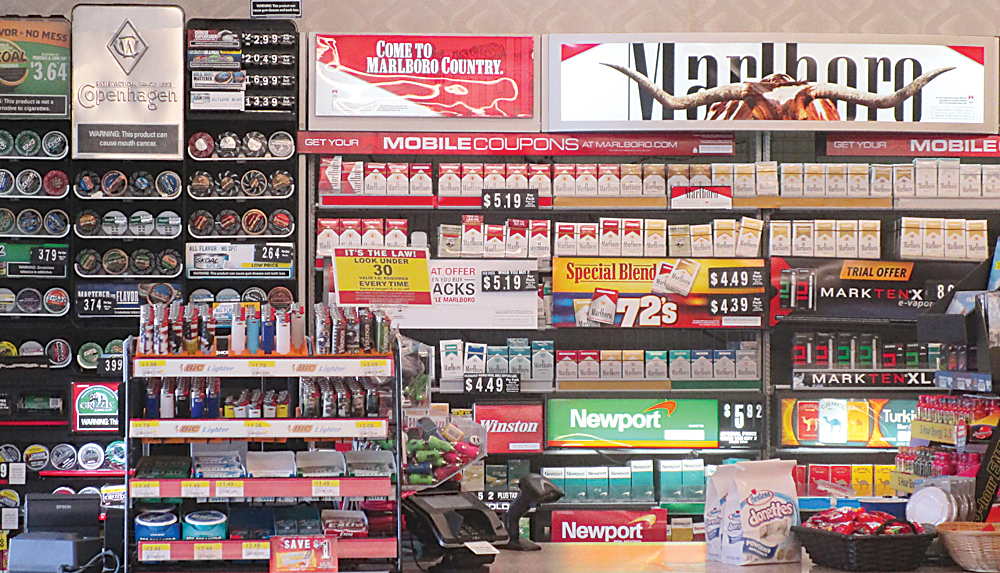
Example of a tobacco "power wall" commonly found near cash registers in convenience stores and gas stations.
Tobacco advertising and products are placed prominently in “power walls” near or behind cash registers in retail outlets like convenience stores and gas stations, such that all customers are exposed to this marketing. This widespread and frequent exposure to tobacco retail is of great interest in tobacco control and cancer prevention research worldwide.
Research Evolution
Prior Research on Tobacco Retail Exposure
Prior work suggests detrimental associations between exposure to tobacco marketing and smoking outcomes including increased odds of failed cessation attempts, craving, purchase urges, and impulse purchases. To enhance ecological validity, some of this prior research has utilized place-based research approaches to investigate associations between tobacco retail exposure and smoking outcomes. In these studies, a participant’s home address or neighborhood is commonly used to approximate real-world exposure, which is then later mapped to health behaviors, such as smoking.
While neighborhood approximated research has provided key insights, it lacks ability to evaluate exposures dynamically and within individuals across time. People’s daily lives often involve mobility, such as traveling for work, errands, or recreation. A pivotal study compared tobacco retail exposure estimates using neighborhood approximated exposure to real-time geolocation tracking and found that 55% of the variance accounted for by geolocation tracking was not accounted for using neighborhood approximated exposure.
This suggests that approximating tobacco retail exposure using geolocation tracking is a significant upgrade from neighborhood approximated exposure, allowing researchers to measure environmental exposures more precisely, both geographically and temporally, as opposed to relying on a single, non-representative proxy or self-reported exposure. Using geolocation tracking, exposure to tobacco retailers has been linked to adolescents’ daily smoking, as well as to smoking cessation success in adults. However, minimal prior work has assessed real-time, longitudinal, and naturalistic associations between tobacco retail exposure and smoking outcomes in adults who smoke daily, which adds to smoking-related health burdens.
Experimental Approaches to Understanding Tobacco Retail Effects
Bridging the Gap from Correlation to Causation
While modern technology enables better measurement of real-world exposures, experimental approaches are needed to establish causality between tobacco retail exposure and smoking behaviors.
Leveraging modern technology is key to gaining real-world insights about tobacco retail exposure and smoking outcomes, but the approach described above is inherently correlational. Thus, another key question that remains is whether real-world tobacco retail exposure has causal impacts on craving and smoking.
Virtual Store Studies
Online simulations of retail environments
Store Replica Research
Full-size convenience store mockups
Image Exposure Tests
Controlled viewing of tobacco marketing images
Recent work has used online, virtual stores, as well as full-size convenience store replicas, to test causal effects of exposure to retail and retail marketing. This work has found that removing retail marketing, or reducing its visibility, reduces purchase attempts, urges to smoke, and scores on a smoking susceptibility survey. In an online experiment, individuals who currently smoked reported greater craving after viewing point-of-sale cigarette promotion cues compared to non-smoking cues, which provides evidence that viewing images of tobacco marketing can increase craving.
Together, these experimental studies have utilized randomized and controlled designs in tightly structured environments, strengthening internal validity for the effects of retail exposure on harmful smoking outcomes. However, there remains no research that capitalizes on modern technology to examine real-world casual effects. For example, an ecologically valid and real-world experiment in which levels of tobacco retail exposure are manipulated and smoking outcomes are assessed has not been conducted. Thus, an important question that remains is whether real-world visits to tobacco retailers have effects on craving and smoking in daily life, when individuals are not in highly controlled lab settings.
Neural Mechanisms of Smoking Cue Reactivity
Theoretical models and empirical studies of addiction suggest that exposure to drug-cues, such as images of drug paraphernalia, enhances craving and consumption behavior in drug users, including individuals who smoke. Researchers have investigated the brain mechanisms of these associations, which can facilitate intervention strategies to decrease neural reactivity and exposure to cues known to elicit reward activation.
Laboratory work has shown increased neural activity in regions associated with drug cue-reactivity as well as increased ratings of subjective craving after exposure to smoking cues such as pictures of cigarettes. Craving ratings scale positively with neural cue-reactivity, and both metrics predict smoking behaviors in a later ad-lib smoking session. Neural cue reactivity effects have been generalized from completely standardized cues to more naturalistic pictures of personal smoking environments, such that exposure to photographs of places where participants often smoke (e.g., one’s home) evokes stronger neural and behavioral craving responses than exposure to generic photographs (e.g., an unfamiliar bus stop).
Recent work assessed neural responses to photographs of familiar or unfamiliar tobacco retailers and found higher responses in regions related to self-relevance and smoking motivation; however, this study did not assess self-reported craving in response to different image categories. Thus, laboratory experiments implicate neural smoking cue reactivity and cigarette craving as mechanisms linking exposure to smoking cues and behavior, but significant questions remain about whether viewing tobacco marketing elicits activation in the same brain regions as standardized, proximal smoking cues like pictures of cigarettes, and, crucially, whether in-scanner brain activation is related to individuals’ real-world levels of tobacco retail exposure.
The GeoSmoking Study
Ultimately, cigarette smoking remains one of the top health concerns globally, and an extensive scientific literature has identified and examined tobacco retail exposure as one of the sources for this issue. Despite progress, there remains a lack of research utilizing naturalistic and time-sensitive approaches, evaluating real-world effects of tobacco marketing on smoking outcomes, and examining neural cue reactivity to marketing cues as a mechanistic explanation for the effects of tobacco retail marketing on behavior.
The GeoSmoking Study seeks to address these gaps through an innovative and multimodal protocol, leveraging insights and methods from across the social sciences. Specifically, we recruited adults who smoked cigarettes daily and who lived in one of three U.S. states (Pennsylvania, Delaware, and New Jersey) to participate in a remote, longitudinal study. In a baseline period, we used ecological momentary assessment (EMA) to capture reports of craving and smoking throughout the day, and geolocation tracking to assess real-world mobility. We curated a database of all tobacco retailers across the three states, and used this to assess participants’ real-world tobacco retail exposure.
The baseline period was followed by a longitudinal experiment period in which participants’ levels of tobacco retail exposure were manipulated by assigning them to enter an assigned store every day, while geolocation tracking and EMA continued. Participants were assigned to either enter a tobacco retail store (Tobacco retailer condition) or a non-tobacco retail store (Non-tobacco retailer condition), or to follow their normal routines (Control condition). The study concluded with an optional, in-person functional magnetic resonance imaging (fMRI) visit in which participants completed image rating tasks, which included tobacco marketing cues.